BABAR untagged B0+B+ (6 q2 bins)
BABAR untagged B0+B+ (12 q2 bins)
Belle untagged B0
Belle hadronic tag B0 and B+
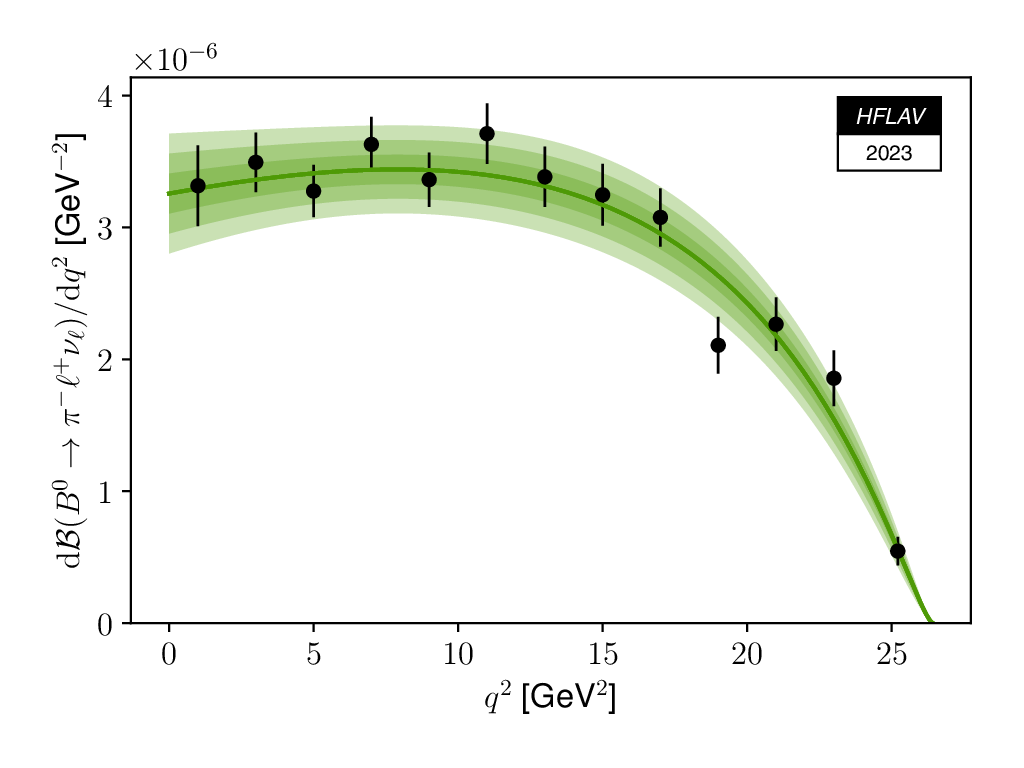
In the first step of the averaging prodcedure, an average q2 spectrum is determined
from the measurements listed above. A plot of the average q2 spectrum can be found here:
pdf
The p-value for this average is 0.40.
The total branching fraction is then calculated from the sum
of the partial branching fractions in the average q2 spectrum,
taking the correlations between q2 bins into account:
| Experiment / Mode | BF [10-4] |
|---|---|
| Average: B0 -> pi- l+ nu | 1.50 +/- 0.02 +/- 0.05 |
|Vub| is determined from a combined fit of a B -> pi form factor parameterization to theory predictions and the average q2 spectrum in data.
The theory input included in the fit is the results from the FLAG lattice average (S. Aoki et al., [arXiv:2411.04268 [hep-ph]])
For the form factor parameterization, we use the BCL parameterization (Bourrely, Caprini and Lellouch, Phys. Rev. D79, 013008 (2009) [arXiv:0807.2722v3 [hep-ph]]) with 3+1 parameters, i.e. 3 parameters for the coefficients b0,b1,b2 in the BCL expansion and one normalization parameter for |Vub|.
The results of the combined fit are:
|Vub| = (3.75 +- 0.06 +- 0.19) × 10-3
b+0 = 0.424 +- 0.0121
b+1 = -0.484 +- 0.043
b+2 = -0.658 +- 0.168
b00 = 0.561 +- 0.024
b01 = -1.393 +- 0.070
The quoted uncertainties on |Vub| are experimental and theoretial, those on the BCL parameters are the combined experimental and theoretical errors obtained from the fit.
The probability of the fit is 0.37.
A plot of the fit result is available here: pdf