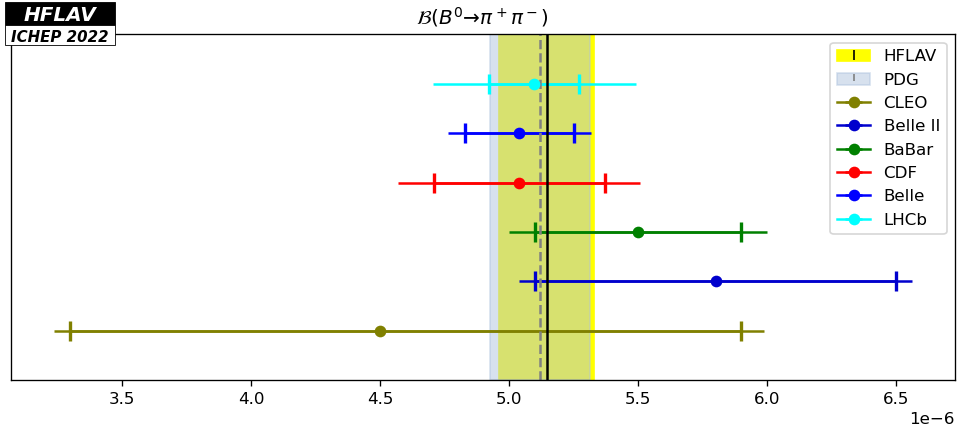
| Experiment | Measurement [10-6] | $\Delta\chi^2$ | Reference | Comments |
|---|---|---|---|---|
| Average | $5.15 \pm0.19$ | 9.75 | $p=0.94$ (ndf=18) | |
| PDG | $5.12 \pm0.19$ | pdgLive | ||
| LHCb | $5.10 \pm0.18 \pm0.35$ using ${\cal B}(B^0 \to K^+ \pi^-)$ | 0.02 | JHEP 10,037 (2012) | |
| Belle | $5.04 \pm0.21 \pm0.18$ | 0.14 | Phys.Rev.D 87,031103 (2013) | |
| CDF | $5.04 \pm0.33 \pm0.33$ using ${\cal B}(B^0 \to K^+ \pi^-)$ | 0.05 | Phys.Rev.Lett. 106,181802 (2011) | |
| BaBar | $5.5 \pm0.4 \pm0.3$ | 0.50 | Phys.Rev.D 75,012008 (2007) | |
| Belle II | $5.8 \pm0.7 \pm0.3$ | 0.74 | arXiv:2106.03766 | |
| CLEO | $4.5\,^{+1.4}_{-1.2}\,^{+0.5}_{-0.4}$ | 0.21 | Phys.Rev.D 68,052002 (2003) |
| Source | Parameter | Correlation [%] | Value | $\Delta\chi^2$ |
|---|---|---|---|---|
| fit | ${\cal B}(B^0 \to K^+ \pi^-)$ | 25.4 | $1.946 \pm0.046 \times 10^{-5}$ | |
| fit | ${\cal B}(B_s^0 \to K^+ K^-)$ | 5.2 | $2.66\,^{+0.32}_{-0.27} \times 10^{-5}$ | |
| fit | ${\cal B}(B_s^0 \to K^- \pi^+)$ | 4.2 | $5.90\,^{+0.87}_{-0.76} \times 10^{-6}$ | |
| fit | ${\cal B}(B_s^0 \to \pi^+ \pi^-)$ | 3.9 | $7.2\,^{+1.1}_{-1.0} \times 10^{-7}$ | |
| fit | ${\cal B}(B^0 \to K^+ K^-)$ | 3.1 | $8.0 \pm1.5 \times 10^{-8}$ | |
| fit | ${\cal B}(\Lambda_b^0 \to p \pi^-)$ | 2.0 | $4.55\,^{+0.91}_{-0.82} \times 10^{-6}$ | |
| fit | ${\cal B}(\Lambda_b^0 \to p K^-)$ | 1.7 | $5.4 \pm1.1 \times 10^{-6}$ | |
| fit | ${\cal B}(\Lambda_b^0 \to \Lambda^0 \phi(1020))$ | -0.3 | $1.01\,^{+0.29}_{-0.25} \times 10^{-5}$ | |
| fit | ${\cal B}(B^0 \to \phi(1020) K^0)$ | -0.0 | $7.25 \pm0.60 \times 10^{-6}$ | |
| fit | ${\cal B}(B_s^0 \to K^0 \bar{K}^0)$ | -0.0 | $1.74 \pm0.31 \times 10^{-5}$ | |
| external | $f_{\Lambda^0_b}$ | 0.6 | $8.1 \pm1.1 \times 10^{-2}$ | 0.09 |
| external | $\frac{f_s}{f_d}$ | 0.2 | $0.241 \pm0.023$ | 0.05 |
| external | $f_{d}$ | -0.1 | $0.4083 \pm0.0070$ | 0.00 |