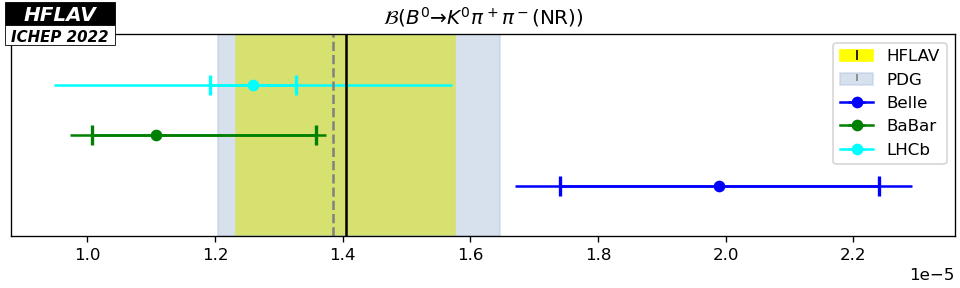
| Experiment | Measurement [10-5] | $\Delta\chi^2$ | Reference | Comments |
|---|---|---|---|---|
| Average | $1.40 \pm0.17$ | 30.00 | $p=0.0016$ (ndf=11) | The PDG uncertainty includes a scale factor. |
| PDG | $1.39\,^{+0.26}_{-0.18}$ | pdgLive | ||
| LHCb | $1.260 \pm0.067 \pm0.305$ using ${\cal{B}}(B^0 \to K^0 \pi^+ \pi^-)$ | 0.22 | Phys.Rev.Lett. 120,261801 (2018) | Result extracted from Dalitz-plot analysis of $B^0 \to K_S^0 \pi^+ \pi^-$ decays. The nonresonant component is modelled as a flat contribution over the Dalitz plane. Multiple systematic uncertainties are added in quadrature. |
| BaBar | $1.107\,^{+0.251}_{-0.099} \pm0.090$ | 1.25 | Phys.Rev.D 80,112001 (2009) | Result extracted from Dalitz-plot analysis of $B^0 \to K_S^0 \pi^+ \pi^-$ decays. This value incldues the flat NR component and the effective range of the LASS lineshape. The value corresponding to the flat component alone is also given in the article. Multiple systematic uncertainties are added in quadrature. |
| Belle | $1.99 \pm0.25\,^{+0.17}_{-0.20}$ | 3.34 | Phys.Rev.D 75,012006 (2007) | Result extracted from Dalitz-plot analysis of $B^0 \to K_S^0 \pi^+ \pi^-$ decays. The nonresonant component is modelled using a sum of two exponential functions. |
| Source | Parameter | Correlation [%] | Value | $\Delta\chi^2$ |
|---|---|---|---|---|
| fit | ${\cal B}(B^0 \to (K\pi)^{*+}_{0} \pi^-) \times {\cal B}((K\pi)^{*+}_{0} \to K^0 \pi^+)$ | 3.9 | $1.86 \pm0.11 \times 10^{-5}$ | |
| fit | ${\cal B}(B^0 \to K^*(892)^+ \pi^-)$ | 3.8 | $7.64 \pm0.44 \times 10^{-6}$ | |
| fit | ${\cal B}(B^0 \to K_2^*(1430)^+ \pi^-)$ | 3.3 | $3.82 \pm0.36 \times 10^{-6}$ | |
| fit | ${\cal B}(B^0 \to K^*(1680)^+ \pi^-)$ | 3.2 | $1.47 \pm0.14 \times 10^{-5}$ | |
| fit | ${\cal B}(B^0 \to f_0(980) K^0) \times {\cal B}(f_0(980) \to \pi^+ \pi^-)$ | 1.8 | $8.38 \pm0.61 \times 10^{-6}$ | |
| fit | ${\cal B}(B^0 \to \chi_{c0} K^0) \times {\cal B}(\chi_{c0} \to \pi^+ \pi^-)$ | 1.5 | $1.16\,^{+0.25}_{-0.21} \times 10^{-6}$ | |
| fit | ${\cal B}(B^0 \to \rho^0(770) K^0)$ | 1.4 | $3.45 \pm0.48 \times 10^{-6}$ | |
| fit | ${\cal B}(B_s^0 \to K^0_S K^*(892)^0 \mathrm{+c.c.})$ | 1.2 | $1.71 \pm0.43 \times 10^{-5}$ | |
| fit | ${\cal B}(B_s^0 \to K^*(892)^- \pi^+)$ | 0.6 | $3.0 \pm1.1 \times 10^{-6}$ | |
| fit | ${\cal B}(B^0 \to f_0(1500) K^0) \times {\cal B}(f_0(1500) \to \pi^+ \pi^-)$ | 0.5 | $1.35 \pm0.79 \times 10^{-6}$ | |
| fit | ${\cal B}(B^0 \to f_0(500) K^0)$ | 0.2 | $1.7\,^{+2.6}_{-1.6} \times 10^{-7}$ | |
| external | ${\cal{B}}(B^0 \to K^0 \pi^+ \pi^-)$ | 9.2 | $5.18 \pm0.17 \times 10^{-5}$ | 1.25 |
| external | ${\cal B}(K^*(1680)^+ \to K \pi)$ | -0.0 | $0.387 \pm0.025$ | 0.00 |
| external | ${\cal B}(K_2^*(1430)^+ \to K \pi)$ | -0.0 | $0.499 \pm0.012$ | 0.00 |